The State of Australian Migration Agents in 2026
Migratio Editorial · Last updated
TL;DR: Migratio analysed all 5,489 current MARA registrations. New agent registrations collapsed roughly 85% after the 2018 entry-requirement changes (417 in 2018 to just 62 in 2020), and only recovered to a decade high of 457 in 2025. The median agent has been registered 10 years, Victoria hosts more agents than New South Wales, and about half of all registered agents have no website.
Watch the 2-minute video version, with chapters and a transcript
Who actually makes up Australia's migration advice profession? Migratio analysed the full register of 5,489 currently registered migration agents — their registration years (encoded in every MARN), locations, practice areas, languages, and digital presence — to build the most complete public picture of the profession in 2026. The headline: the profession is older and more experienced than most applicants assume, it nearly stopped recruiting new members between 2019 and 2021, and it is only now rebuilding its pipeline.
Data and media downloads
Journalists, researchers and students may download and cite these aggregate files with attribution to Migratio. Media enquiries: admin@migratio.com.au.
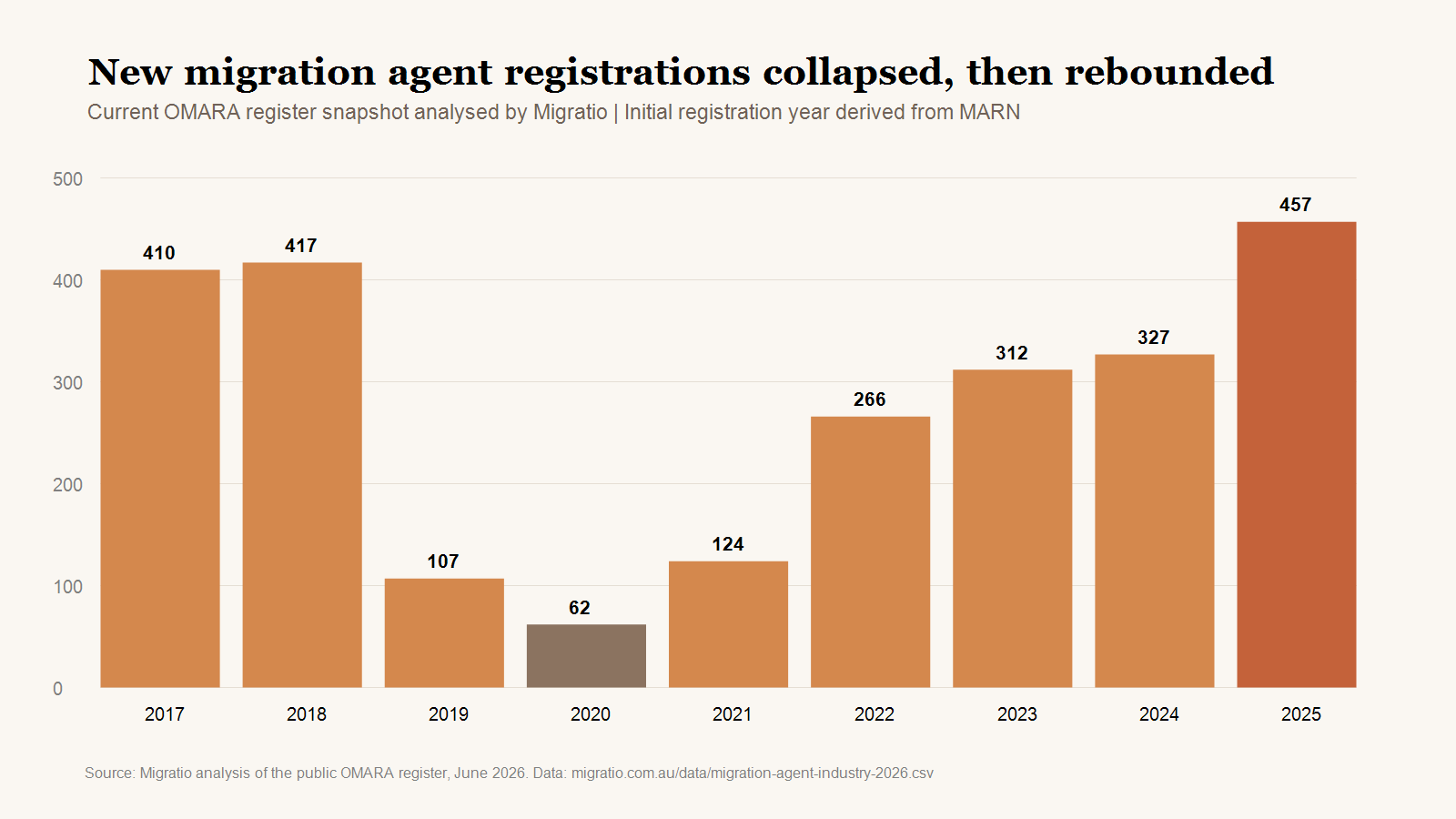
New agent registrations collapsed 85% after 2018 — and just hit a decade high
Every MARN encodes the year its holder first registered, which makes the register a time series of the profession's intake. The numbers tell a dramatic story: 410 new agents registered in 2017 and 417 in 2018 — then just 107 in 2019 and 62 in 2020, an approximately 85% collapse in two years. The timing matches the lift in entry requirements (the move from the Graduate Certificate to the Graduate Diploma in Australian Migration Law and Practice plus the Capstone assessment, phased in from 2018) followed by COVID-19 border closures gutting demand. Recovery was slow — 124 new registrations in 2021, 266 in 2022, 312 in 2023, 327 in 2024 — before 2025 delivered 457 new agents, the strongest intake in a decade. For applicants, the practical consequence of that 2019–2021 trough is a missing generation of mid-career agents: the profession skews either very experienced or very new.
The median registered agent has 10 years on the register
Across all 5,489 current registrations, the median agent has been registered for 10 years and the average is 11.1 years. Some 847 agents — about 15% of the register — have held registration for 20 years or more, 1,726 (31%) for 15+ years, and 2,851 (52%) for a decade or more. At the other end, 1,518 agents (28%) have been registered for under five years, most of them part of the 2022–2026 recovery cohort. Experience on the register is not the same thing as case quality, but it is a useful first filter — and it is verifiable by anyone, because the registration year is baked into the agent's MARN.
Victoria, not New South Wales, has the most migration agents
Counter to what most people would guess, Victoria hosts the largest agent population: 1,244 agents with a listed Victorian address, ahead of New South Wales on 1,087, Queensland on 490, Western Australia on 390 and South Australia on 199. The ACT (64), Tasmania (24) and the Northern Territory (18) round out the onshore numbers. Melbourne is the single biggest agent city with around 310 listed agents in the CBD alone, ahead of Sydney's roughly 255; Parramatta is the largest non-CBD hub. A further large group of registered agents — more than a third of the register — list no Australian state at all, most of them practising from overseas, which reflects how thoroughly digital Australian migration practice has become: the Department of Home Affairs operates entirely online, so an agent's physical location rarely limits who they can act for.
Half the profession has no website
Of 5,489 registered agents, only 2,762 — almost exactly half — have a working website associated with their registration. The rest practise on referrals, community word of mouth, and repeat clients. For applicants this matters in two ways. First, the absence of a website says little about quality: some of the most experienced agents on the register have the thinnest digital presence. Second, it explains why finding and comparing agents has historically been so hard — half the market is effectively invisible to a Google search, which is the gap directories and comparison platforms exist to close.
What agents actually work on
Among the roughly 1,800 agents whose published practice information allowed classification, student and graduate visa work is the most commonly cited practice area (about 1,000 agents), followed by skilled and points-tested migration (~740), employer-sponsored work (~560), family and parent visas (~525), and partner visas (~450). Around 310 publicise refusal, appeal and tribunal work, and roughly 100 cite humanitarian and protection cases. The pattern mirrors visa demand itself, but the long tail matters: complex areas like refusals and humanitarian work are concentrated in a small minority of practitioners, which is why applicants in those situations benefit most from finding a genuine specialist rather than the nearest agent.
Languages: the profession under-represents its client base
Among agents who publish the languages they work in, Spanish leads, followed by Mandarin, Vietnamese, Portuguese, French, Russian, Arabic, Italian and Cantonese. But the more striking finding is how few agents advertise any language capability at all — only a few hundred of 5,489 — despite the overwhelmingly multilingual client base of Australia's migration program. For applicants who would prefer advice in their first language, this is a real but solvable search problem; for agents, publishing language capability is one of the simplest unexploited marketing advantages in the profession.
How this analysis was done
Migratio maintains a periodically refreshed copy of the public register of migration agents published by the Office of the Migration Agents Registration Authority (OMARA), covering every currently registered agent. Registration years are derived from the MARN itself (the first two digits encode the initial registration year). Practice areas and languages were extracted from each agent's own published practice information and are indicative rather than exhaustive — an agent without a published specialisation may still handle that work. The counts on this page were taken in June 2026, from the same register copy that then ran until Migratio's next full refresh against the live OMARA register on 8 September 2026 — a refresh that removed 157 agents no longer on the register and added 258 new registrations, moving the total to a different figure. Registration-year and tenure counts are unaffected by any single refresh (a MARN's encoded year never changes) but state, website and total-count figures here reflect the register as it stood in June 2026, not today. This analysis may be cited freely with a link to this page; for media enquiries or the underlying aggregates, contact Migratio.
Frequently asked questions
How many registered migration agents are there in Australia in 2026?
There were 5,489 registered migration agents on the OMARA register in June 2026, when this analysis was run — a later refresh against the live register in September 2026 changed the total. In June 2026, Victoria had the largest state cohort (1,244), followed by New South Wales (1,087) and Queensland (490). More than a third of registered agents listed no Australian state, most practising from overseas.
Why did new migration agent registrations collapse after 2018?
Entry requirements were significantly lifted from 2018 — prospective agents now complete the Graduate Diploma in Australian Migration Law and Practice and a Capstone assessment, replacing the shorter Graduate Certificate pathway. New registrations fell from 417 in 2018 to 107 in 2019 and 62 in 2020, with COVID-19 border closures compounding the drop. Intake only returned to pre-change levels in 2025, with 457 new registrations.
How experienced is the average Australian migration agent?
The median currently registered agent has held registration for 10 years (the mean is 11.1 years). About 15% of agents have been registered 20+ years, and just over half have a decade or more on the register. You can estimate any agent's registration year yourself: the first two digits of their MARN encode it.
Can a migration agent in another state or overseas handle my case?
Yes. Australian migration practice is fully digital — the Department of Home Affairs accepts lodgements and correspondence online — so a registered agent can act for you regardless of where they or you are located. What matters is current MARA registration (verifiable on the OMARA register) and relevant experience with your visa type.
Compare MARA-registered migration agents
Related: How to Choose a Migration Agent in Australia · How Much Does a Migration Agent Cost in Australia? · How to Check If a Migration Agent Is MARA Registered (OMARA Lookup Guide) · Migration Agent vs Immigration Lawyer in Australia · Australian Immigration Statistics: 11 Years of Official Data · Australia's Migration Program: planned versus delivered, 2015-16 to 2024-25 · How often are migration agents actually sanctioned?